

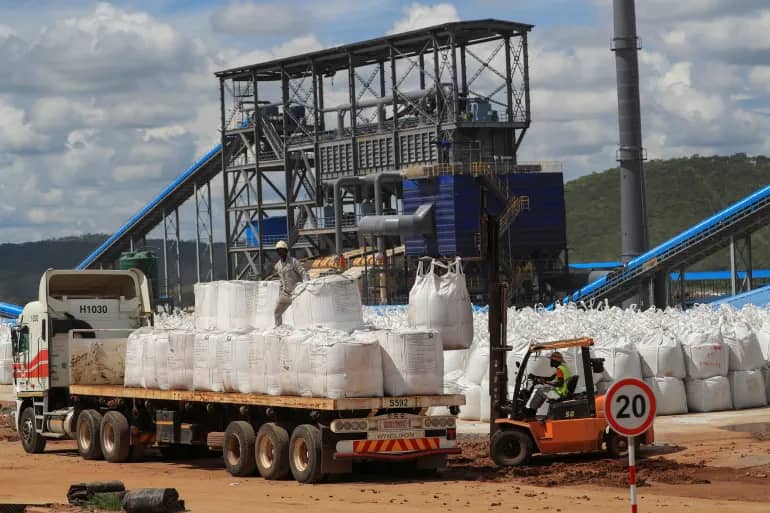
Who benefits from Zimbabwe lithium boom? Community gains remain uneven

Who benefits from Zimbabwe lithium boom? Community gains remain uneven
For all the News from Mashonaland Central, Join One of Our Groups
Zimbabwe’s lithium sector is expanding through a small number of large-scale, foreign-backed projects, but analysts and resource governance advocates say community benefits remain uneven even as export earnings rise.
Major producers cited in an Al Jazeera report include Bikita Minerals in Masvingo Province, Prospect Lithium Zimbabwe’s Arcadia Mine near Harare in Goromonzi, Kamativi Lithium Mine in Matabeleland North, Sabi Star Lithium Mine in Buhera, Sandawana Mine in Mberengwa and Gwanda Lithium Mine in Matabeleland South. The report said most major projects are backed by Chinese investment.
The country’s push to move beyond raw mineral exports gained momentum in April when Prospect Lithium Zimbabwe (PLZ) announced its first export of lithium sulphate, a higher-value processed product produced at a recently commissioned US$400 million processing facility at Arcadia.
In a post on X dated April 27, PLZ said: “History has been made. Arcadia Technology Zimbabwe has successfully dispatched its first export of lithium sulphate, a landmark achievement for both the company, the country and the continent.”
PLZ is wholly owned by Zhejiang Huayou Cobalt, according to the report. Al Jazeera said it contacted PLZ communications manager Patience Mushore, who initially indicated responses would be provided but later declined to comment and referred the outlet to previously published statements.
Separately, Bikita Minerals said it is aligning operations with Zimbabwe’s beneficiation strategy through a US$400 million investment programme aimed at moving from lithium concentrate exports to lithium precursor chemicals. In a statement cited by Al Jazeera, the company said the first phase of its lithium sulphate project is expected to be commissioned in the second quarter of 2027 with annual output capacity of 60,000 tonnes. The company also said it has established in-house assay laboratories for mineral testing, quality control and export compliance.
Mutapa Energy Minerals, a subsidiary of the state-owned Mutapa Investment Fund, is also preparing to develop a lithium concentrate processing plant at Sandawana Lithium Mine in partnership with Zhejiang Huayou Cobalt and Tsingshan Holding Group, according to the report.
Government’s mineral export policy was linked to rising export figures. Al Jazeera reported that Minerals Marketing Corporation of Zimbabwe (MMCZ) data shows mineral sales reached US$983.85 million in the first quarter of 2026, export volumes increased 27 percent and export values rose 79 percent following a ban on exports of unprocessed minerals.
According to MMCZ figures cited by Al Jazeera, lithium export earnings rose from US$84.19 million in the first quarter of 2025 to US$178.64 million in the same period in 2026.
State media reports quoted Mines and Mining Development Minister Polite Kambamura saying the sector had generated at least US$2 billion this year and remained on a growth trajectory, with performance attributed to global prices for gold and platinum group metals and growing investment in lithium processing. Al Jazeera said repeated attempts to obtain comment from Kambamura were unsuccessful, with an aide stating the minister spent the week at Senate House, limiting availability.
However, analysts cautioned that increased processing does not automatically translate into broad-based development. Political analyst Rashweat Mukundu told Al Jazeera that domestic processing is positive, but needs sustained investment in infrastructure, technology and industrial capacity. “Revenues from processed lithium are increasing, but the policy should be guided by a long-term strategy rather than a knee-jerk political reaction,” he said, warning that overreliance on China as a market and investor carries risks.
Centre for Natural Resource Governance executive director Farai Maguwu told Al Jazeera that the sector is affected by policy inconsistency, weak infrastructure, limited industrial capacity and inadequate community benefits. He cited concerns raised around communities near Bikita Minerals, Prospect Lithium in Goromonzi and Sabi Star, including damaged roads, limited local employment and insufficient investment in public infrastructure.
Mountain Mujakachi, director of the Bikita Land Institute of Development (BILD), told Al Jazeera that community expectations around beneficiation had not been met, and questioned whether some commitments had been fulfilled. He said infrastructure pledges, including a US$10 million bridge project announced after Sinomine Resource Group acquired Bikita Minerals, had not been fulfilled, and raised concerns around water shortages and environmental impacts. Bikita Minerals, however, said it continues to invest in community development, citing a US$1 million health facility serving more than 5,000 people, nutrition support for nearly 10,000 learners, a 132kV power line project valued at up to US$30 million, and more than US$500,000 spent on road rehabilitation and other community infrastructure.
Zimbabwe Diamond and Allied Minerals Workers Union general secretary Justice Chinhema told Al Jazeera that restricting unprocessed lithium exports aligns with the Africa Mining Vision and industrialisation goals, but said implementation must include social dialogue, unionisation, labour protections, community benefits and revenue transparency. “Value addition must benefit workers and communities through decent jobs, workplace safety and improved infrastructure,” he said.
In Mashonaland Central, where mining and resource governance debates are increasingly prominent alongside farming and small business activity, the key question raised by the lithium boom remains who ultimately benefits — investors, the state, workers, or the communities living with the long-term environmental and infrastructure impacts of extraction and haulage.
As lithium beneficiation projects expand, residents and local leaders across Zimbabwe are likely to keep pressing for clearer community development agreements, transparent reporting on revenues and local procurement, and practical improvements in roads, water systems, schools, clinics and employment opportunities.



Mundubile seeks new party route as Hichilema eyes second term
Mundubile seeks new party route as Hichilema eyes second term For all the News from Mashon…

Baradzanwa Cultural Village Emerges as a Premier New Year Tourism Destination in Mazowe
For all the News from Mashonaland Central, Join One of Our Groups Multitudes of …