


Mining reforms urged to fund climate resilience as Mines Bill advances in Zimbabwe

Mining reforms urged to fund climate resilience as Mines Bill advances in Zimbabwe
For all the News from Mashonaland Central, Join One of Our Groups
Calls are growing for Zimbabwe’s mining sector to play a direct role in financing climate resilience and disaster risk reduction, as the Mines and Minerals Amendment Bill moves through Parliament.
The debate featured strongly at the 3rd Zimbabwe Youth Symposium on Disaster Risk Reduction, held under the theme “From Risk to Resilience: Reclaiming Youth Agency in Disaster Risk Management”. The event was organised by ActionAid Zimbabwe in partnership with the Ministry of Local Government and Public Works and the Department of Civil Protection.
Speakers at the symposium argued that mining governance, environmental protection and disaster preparedness should be treated as one connected issue, particularly as climate-related hazards such as flooding intensify the risks created by poorly regulated extraction.
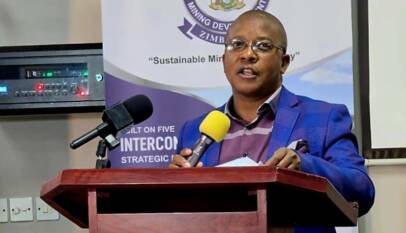
Engineer Shingirai Muzanenhamo, Inspector of Mines (Mechanical and Electrical) in the Ministry of Mines and Mining Development, told the forum that the link between mining oversight and disaster prevention is direct.
“Disaster Risk Reduction and extractive governance are complementary and mutually reinforcing concepts,” Muzanenhamo said. “These two concepts intersect because responsible mining reduces the likelihood of disasters occurring in the first place.”
He said poorly governed mining can contribute to mine collapses, tailings dam failures, land degradation, water pollution, abandoned pits and unsafe artisanal and small-scale mining practices, with climate events such as extreme rainfall and cyclones compounding the danger for surrounding communities.
Muzanenhamo said the Ministry of Mines is seeking to shift from a reactive approach to a preventative one, including stronger mine planning, environmental protection measures, regular inspections, occupational health and safety standards and responsible mine closure requirements.
The Mines and Minerals Amendment Bill has been described as one of the most significant proposed reforms of Zimbabwe’s mining legislation in decades. According to Muzanenhamo, key provisions relevant to disaster risk include strengthening environmental and social considerations in operations, improving regulatory oversight and compliance, enhancing transparency in mineral resource management, and reinforcing protections for communities affected by mining.
Natural Resources Governance Consultant Nobuhle Chikuni told the symposium that, while the Bill presents an opening for reform, it should go further by explicitly embedding climate resilience into mining governance, especially as international climate finance and development funding become more constrained.
“Mining cannot be divorced from the climate agenda,” Chikuni said. “The sector must become an active protagonist in the Just Energy Transition by adopting cleaner, low-emission technologies and directly supporting community-driven climate resilience.”
Chikuni proposed several measures she said could ensure mineral revenues translate into structured protection for communities exposed to disasters. These included a targeted “green levy” on high-value minerals such as lithium and platinum to support climate adaptation initiatives; climate-proofed mine closure plans that require ecological restoration and repurposing of reclaimed land for community use; and incentives for supply chain decarbonisation through investment in low-carbon technologies and renewable energy.
She also suggested ring-fencing a percentage of mining royalties for a national resilience fund to cushion the economy from the costs of climate-induced disasters.
“We routinely insure projects against accidents and operational downtime,” Chikuni said, “yet we lack structured safety nets for climate shocks.”
Chikuni further argued that voluntary Corporate Social Responsibility commitments from mining companies are insufficient in high-risk areas, and called for enforceable Corporate Social Investment tied to licences and legal obligations.
Both Muzanenhamo and Chikuni emphasised the role of young people in disaster risk management and in the transition to greener skills, including environmental monitoring, ecological restoration, renewable energy systems and other climate-friendly technical capacities.
Muzanenhamo said disaster risk reduction cannot be carried by one ministry alone and requires coordination across government departments, industry, academia and communities. Speakers said the Mines and Minerals Amendment Bill will only achieve its aims if institutions are aligned, accountability mechanisms are effective and communities are actively engaged.
As Parliament considers the proposed legal reforms, participants at the symposium argued that Zimbabwe’s mineral wealth could be used not only for economic growth, but also to protect communities from hazards worsened by climate change.
“By reforming our revenue-sharing models today,” Chikuni said, “we ensure that Zimbabwe’s subterranean wealth directly finances the sustainable resilience of its people tomorrow.”






Mundubile seeks new party route as Hichilema eyes second term
Mundubile seeks new party route as Hichilema eyes second term For all the News from Mashon…

Baradzanwa Cultural Village Emerges as a Premier New Year Tourism Destination in Mazowe
For all the News from Mashonaland Central, Join One of Our Groups Multitudes of …